AI agents in the factory: why 8D decisions should stay with people
 Serhat Altunoğlu
· 4 min read
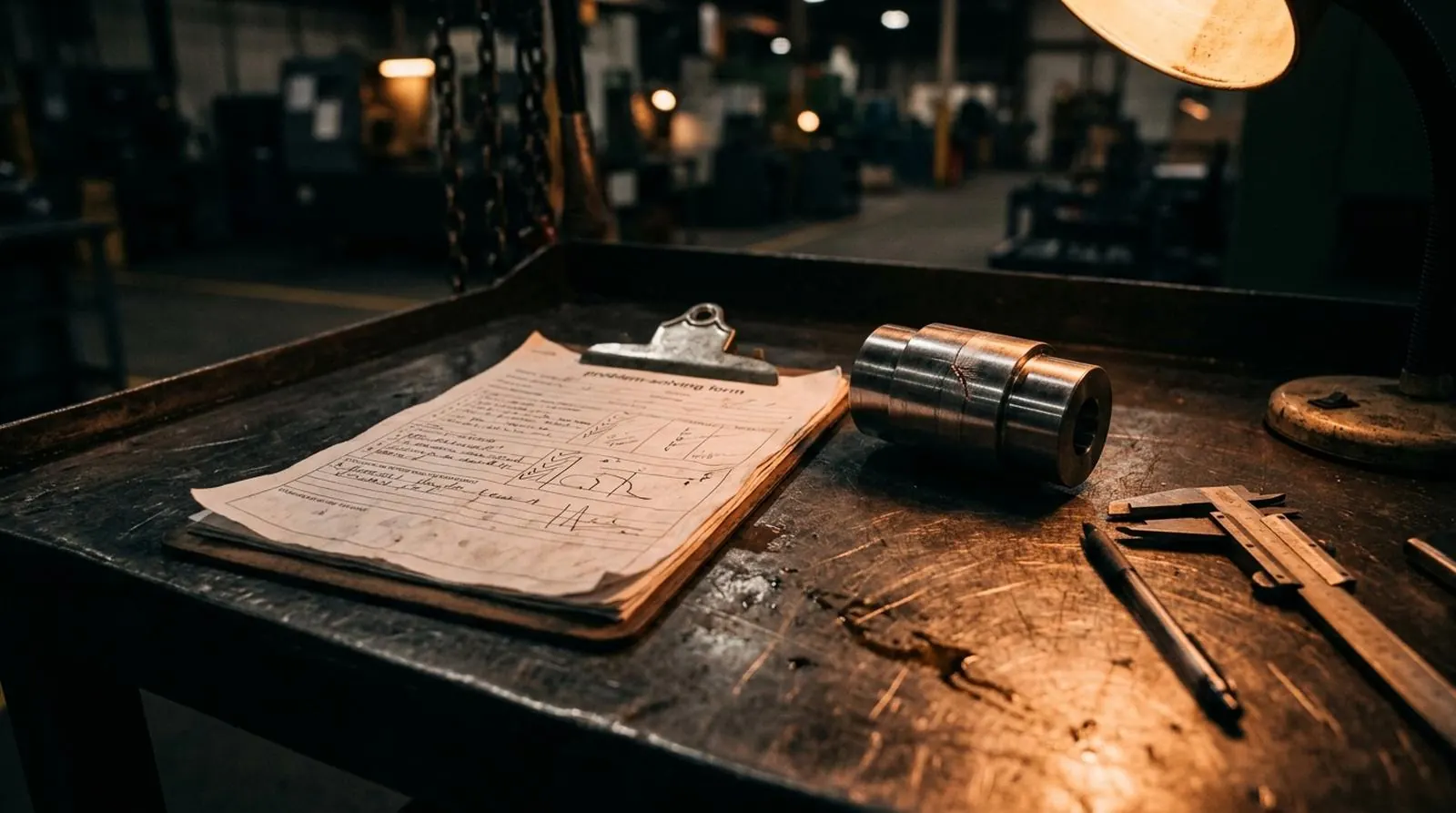
When a customer complaint comes in, your quality team has a long job ahead. Data is collected, meetings are held, emails go out to the supplier, and the 8D report is filled in step by step.
An AI agent can really take over part of this load. But which part?
In automotive, I worked on Hyundai and Ford vehicle programs and carried out 30+ supplier audits. Along the way, I learned one thing: an 8D that looks complete on paper does not show that the problem is solved. In this article, I explain what an agent can safely prepare in an 8D, and where the decision must stay with your team.
A map of the 8D: who does what?
In the map below, each step has two lines. The top line is the draft the agent can prepare. The bottom line is the decision your team has to make.
- D1Form the teamAgentLists who took part in similar past 8Ds.TeamChooses the team and the person in charge.
- D2Problem descriptionAgentDrafts it from the complaint record, rejection data and measurements.TeamChecks the draft against the shop floor and approves it.
- D3ContainmentAgentLists the parts in stock, in transit and at the customer.TeamDecides whether to sort parts or stop shipments.
- D4Root causeAgentLists candidate causes under fishbone headings, along with similar past complaints.TeamVerifies the real cause on the shop floor.
- D5Choose permanent corrective actionAgentCollects the actions taken on similar problems in the past.TeamChooses the action and gets customer approval if needed.
- D6Implement and verifyAgentPrepares due-date reminders and supplier emails.TeamUses data to verify that the action works.
- D7Prevent recurrenceAgentLists similar products and lines where the action could be applied.TeamDecides where to apply it and updates the FMEA and the control plan.
- D8ClosureAgentCompiles the report summary and the timeline of events.TeamCloses the report and recognizes the team.
Drafts an agent can safely prepare
A large part of an 8D is collecting data and writing. In this part, an agent lightens your quality engineer's load. These are the four most useful drafts:
- Problem description (D2): What happened, where, when, in how many parts, in which lots? The agent collects the answers from the complaint record, rejection data and measurement results, and combines them into one draft.
- Root cause candidates (D4): The agent lists possible causes under fishbone (Ishikawa) headings. It places similar past complaints and the related FMEA lines next to them. These are only candidates, not conclusions.
- Timeline: Which lot was produced when, and what changed in the process during that period? The agent works this out from production, shipping, shift and change records.
- Supplier emails: It drafts emails to request missing information, to remind about analysis results and to follow up on due dates. Your team still reads and sends each email.
With these drafts, your team does not write the report from scratch every time. It can spend its time on the issues that really need thought.
Why should the decision stay with your team?
Some steps of an 8D cannot be handled with a draft. They require going to the shop floor, taking responsibility and, often, talking to the customer.
- Verifying the root cause: The agent lists possible causes, but the real cause is found on the shop floor. You take the part in your hands, talk to the operator and, if needed, try to reproduce the defect. The Toyota Production System principle of “go and see” (genchi genbutsu) applies here too.
- Containment (D3): What happens to the parts in stock, in transit and at the customer? Will you sort them, or stop shipments? The cost of this decision and its effect on the customer are directly your responsibility.
- Permanent corrective action (D5 and D6): It requires process changes, control plan and FMEA updates, and sometimes customer approval.
- Customer communication: What you tell the customer, and when, is not just correspondence. It is part of the trust built over years.
An agent can write up the wrong root cause in convincing language. The report looks tidy, but the problem stays on the line.
An action based on the wrong root cause brings the problem back after a while. That is why the agent prepares and the quality team decides.
Before you start: data and access
An agent can only be built on a process that is measured. If your complaint records are scattered and your rejection data sits in separate spreadsheets, the agent will produce scattered drafts too. So start by making clear where the data is:
- Which sources will the agent access: complaint records, ERP, measurement data, supplier correspondence?
- What does your contract with your customer say about confidential information such as customer drawings and technical documents?
- Where will the drafts the agent produces be stored, and who will be able to see them?
The answers to these questions should be set in writing before the pilot starts.
A four- to six-week pilot
There is no need to change the whole quality process at once. Start with a single product family or a single customer. Give the pilot an owner: your quality manager or an experienced quality engineer who knows 8D well. That person reads the drafts and makes the decisions.
- 1Test on past casesPick three to five closed 8Ds. Compare the agent's drafts with what your team wrote at the time.
- 2Drafts onlyOn new complaints, the agent prepares drafts. Nothing goes out without approval.
- 3A decision on every draftThe quality engineer approves, corrects or rejects each draft and notes why.
- 4Review togetherDid the report take less time to prepare? What did the agent miss or point in the wrong direction?
This review helps you decide whether to expand the agent's scope. You can try the same approach for shift summaries and supplier follow-up too.
The operations consulting I offer to manufacturing companies also includes setting up agents for supplier follow-up, 8D drafts and shift summaries. You can see the scope, and how the work is split between the agent and your team, on the AI agents in manufacturing page.
Short answers to common questions about AI agents in factories: AI agents in manufacturing: 8D, OEE and quality.
16 short questions, a quick assessment across eight areas. No scoring.
Free Visibility Check