Solutions for what you need.

Visibility and inquiries for experts, operations for manufacturing companies. The same rule applies to every solution: the agents prepare, and the decision stays with you.

For experts and consultants. Visibility, trust and a steady flow of inquiries.

01

Positioning and website

Who it's forExperts and small firms who find it hard to say what they do in one sentence.

Problem

Visitors land on your site, can't tell within a few seconds who you help and with what problem, and leave.

Scope
  • A one-sentence positioning you can stand behind
  • A page structure built on case studies and references
  • A site that opens quickly and works well on a phone
  • Search engine settings and visitor analytics
Brand positioning and visibility: common questions

02

Case study and reference system

Who it's forExperts who do good work but can't show it.

Problem

Your work lives on only in your clients' memory. A new client can't see any of it.

Scope
  • A case study template that follows problem, approach, result
  • A process for asking clients for named references
  • Placing each claim on the E0 to E4 evidence ladder
What the agent does

When a project ends, it prepares a few short questions for your client and drafts a case study from the answers.

What you do

You approve the questions and the draft. Nothing goes to your client without you.

03

LinkedIn profile and content

Who it's forExperts who are on LinkedIn but stay quiet.

Problem

Your profile reads like a resume. Posts are either missing or they summarize other people's ideas.

Scope
  • Profile headline and About section
  • A plan for a few posts a month that carry your own view
  • Your case studies in the Featured section
What the agent does

Turns the notes and voice memos you take in the field into draft posts.

What you do

You edit them in your own voice and publish.

04

Inquiry follow-up and first reply

Who it's forExperts who lose inquiries somewhere between email, phone and LinkedIn.

Problem

Inquiries come in, but the first reply is late and follow-ups get forgotten. A warm conversation goes cold within a few days.

Scope
  • All inquiries collected in one place
  • A simple client tracking sheet (CRM)
  • Reminders for first replies and follow-ups
What the agent does

Logs the inquiry, drafts the first reply and reminds you when it is time to follow up.

What you do

You read the reply and send it.

AI automation: common questions

05

Proposal and meeting prep

Who it's forExperts who spend hours writing proposals and preparing for meetings.

Problem

Every proposal is written from scratch, and meeting prep is left to the last minute.

Scope
  • A proposal template and scope checklist
  • A shared format for meeting notes
What the agent does

Drafts a proposal from your meeting notes. Before a meeting, it puts together a one-page summary of the person and the company from public sources.

What you do

You set the scope and the price.

For manufacturing and operations. Lighter work on the shop floor, decisions kept with the team.

06

AI agents in manufacturing

Who it's forManufacturing companies with a growing quality and supply chain workload.

Problem

Supplier follow-up, 8D reports and shift summaries eat up engineers' time, and little is left for real improvement work.

Scope
  • A 1–2 day on-site review: losses, repetitive tasks and where data lives
  • A written target with a measured baseline (OEE, scrap, 8D time, OTIF)
  • Setting up the first agent, for example for supplier follow-up emails
  • Weekly measurement until we approach the target, and a summary of gains for management
  • Works with your existing ERP, MES and SCADA, independent of any brand
  • Teaching the team how to use it
What the agent does

Drafts the problem description and timeline of an 8D report, writes supplier follow-up emails and summarizes shift data.

What you do

Your team decides the root cause, the permanent corrective action and the message that goes to the customer.

AI agents in manufacturing: common questions

End-to-end AI automation: from supplier to customer

AI regulation 2026: a guide for companies sourcing from China

07

Lean manufacturing and productivity

Who it's forPlants dealing with line stoppages, high scrap or low efficiency.

Problem

The losses are in plain sight, but nobody is sure where they start or how much they cost.

Scope
  • Observation and data collection on the floor
  • Tracking line efficiency (OEE)
  • Line balancing
  • Kaizen events
  • 5S and visual management
  • Kanban and standard work

Six pieces of work, one goal: make losses visible and reduce them for good.

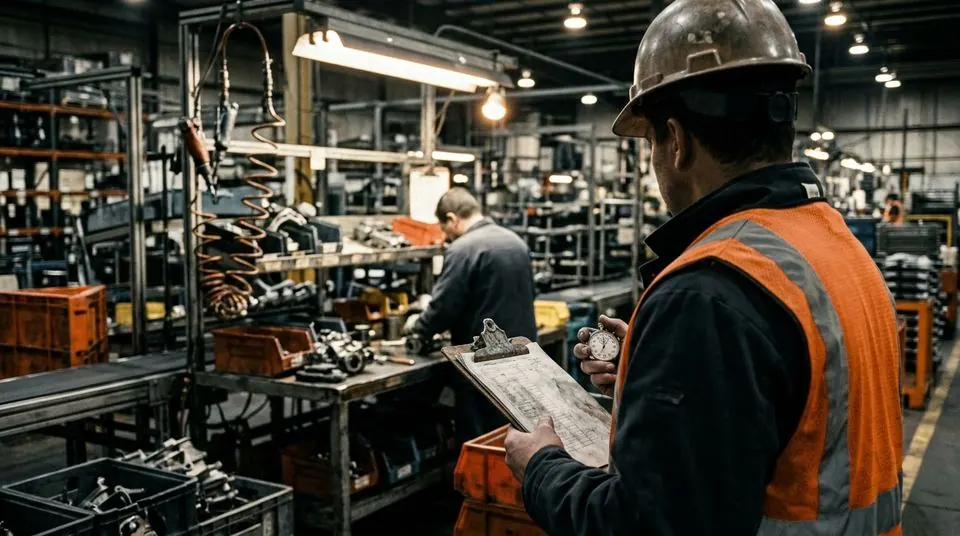
On the shop floor, an engineer with a stopwatch and clipboard watches the work at an assembly station.
01

Observation and data collection

We stand at the line and watch the work as it really happens: cycle times, stoppages, waiting and transport. We rely on measurement, not guesses.

What you getA current-state map of the line and a list of losses.

A large screen above an assembly line showing line status with green, amber and red bars.
02

Tracking line efficiency (OEE)

We measure how much of the line's time actually goes into making good parts. Losses fall into three groups: downtime, slow running and defective parts.

What you getA simple OEE table by shift and the three biggest losses.

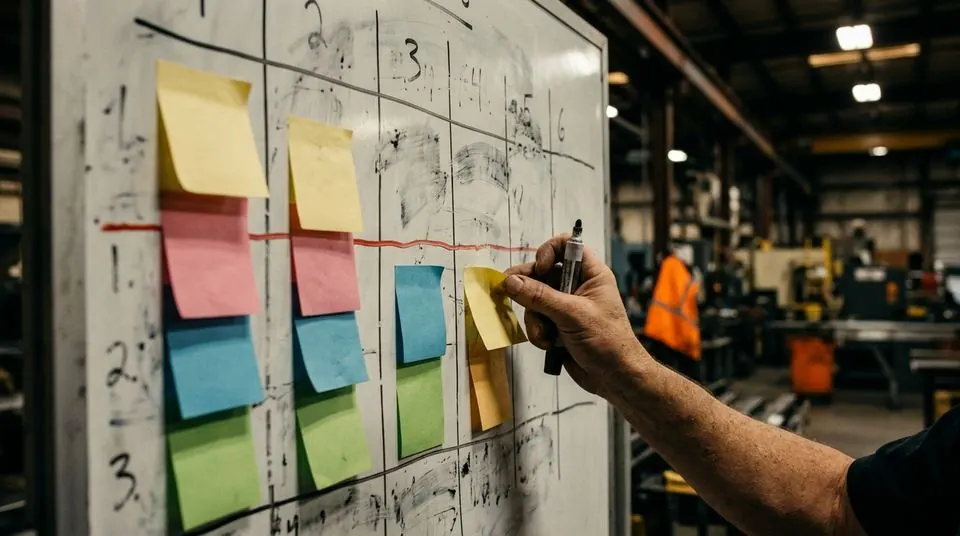
On a factory whiteboard, a workload chart made of colored sticky notes for each station, with a target line.
03

Line balancing

We put the workload of each station side by side, split the work at the bottleneck and spread it to other stations, so the line flows at one pace.

What you getA workload chart by station (yamazumi) and the new work split.

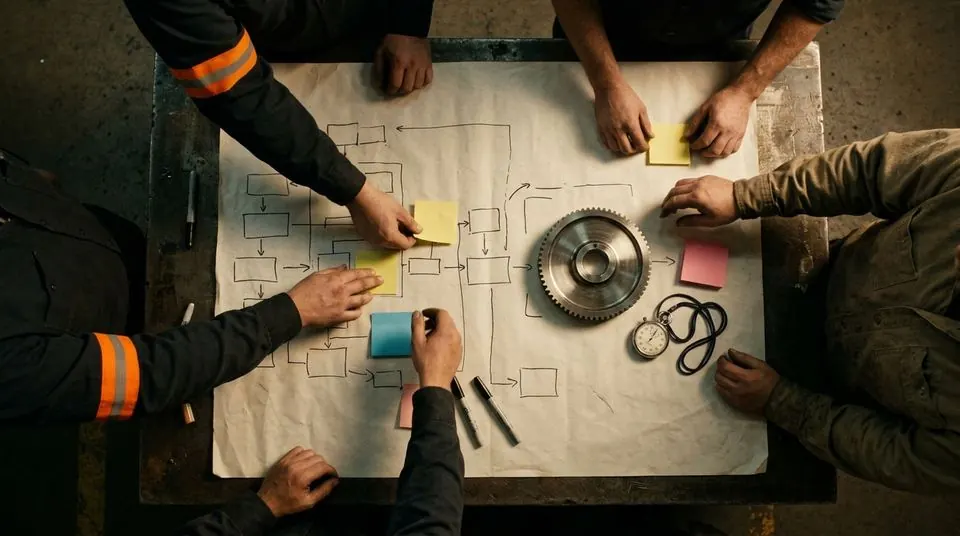
Team members' hands placing sticky notes on a large process map on a table.
04

Kaizen events

Short improvement sessions with the floor team, focused on one problem. The ideas come from the people who do the work every day.

What you getImprovements put into practice, with a before and after record.

A tidy workstation where every tool hangs in its own outlined spot on a shadow board.
05

5S and visual management

Everything has a place, and what is missing shows from a distance. Less time goes into searching and waiting.

What you getOrganized stations and a checklist to keep them that way.

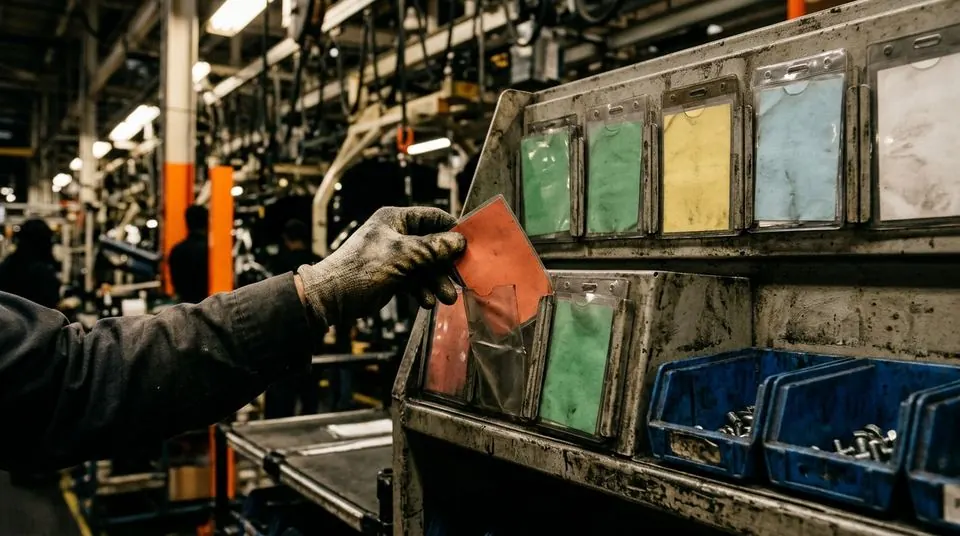
A gloved hand pulling one of the colored kanban cards from a rack next to an assembly line.
06

Kanban and standard work

Material arrives in the right amount, on time. The work is done the best known way, the same way by everyone.

What you getA kanban loop and visual standard work instructions.

How to read OEEThe product of three ratios. A worked example for a fictional line.
  • AvailabilityHow much of the planned time did the line run?90%
  • PerformanceWhile running, how close did it get to target speed?85%
  • QualityHow many parts were good the first time?98%
  • OEE90% × 85% × 98%≈ 75%

Each ratio can look fine on its own. Their product shows how big the loss really is.

How we workEach step builds on the one before.
  1. 1ObserveWe look at the current state on the floor together.
  2. 2MeasureWe record OEE and cycle times.
  3. 3ImproveWe tackle the biggest loss with Kaizen.
  4. 4StandardizeWe make the new method stick with standard work and visual management.

Lean AI automation: flow first, then agents

08

Fractional COO

Who it's forGrowing companies that don't need a full-time head of operations yet.

Problem

The founder is trying to keep up with everything. How things run depends on individuals, and it falls apart as the company grows.

Scope
  • A management routine and key performance indicators (KPIs)
  • Regular team meetings
  • Building company structure and getting ready for investment

The agent prepares. The decision stays with you.

Setup happens in three steps. Below you can see how one inquiry moves from start to finish, along with some example agents.

  1. 01

    Review together

    Together we map how your work runs, where it gets stuck and what takes up most of your time.

  2. 02

    Setup

    I set up agents for the one or two tasks that take the most time. The agents work with the email, calendar and spreadsheets you already use.

  3. 03

    Settling in

    We watch the process together until your team is comfortable working with the agents. Once it runs smoothly, we move on to the next task.

Video · 23 secondsOne inquiry, from start to finish. This is a sample flow. The screens are illustrative and contain no real client data.
Inquiry follow-up

Logs inquiries from your site, email or LinkedIn, drafts the first reply and reminds you when it is time to follow up.

You read the reply and send it.

Content

Turns the notes and voice memos you take in the field into draft LinkedIn posts.

You edit them in your own voice and publish.

Proposal

Turns your meeting notes into a proposal draft and a short summary.

You set the scope and the price.

Case study and reference

When a project ends, it prepares a few short questions to send to your client and drafts a case study from the answers.

You approve the questions and the draft.

Meeting prep

Prepares a one-page summary, from public sources, of the person and company you are about to meet.

You walk into the meeting prepared.

Agents can make mistakes. That is why everything that goes to your client passes your approval first. Before setup, we also agree in writing which information the agents can access.

If you are not sure, start with the free quick assessment. Together we will also see which of your tasks suit an agent.